
Ector County Court Records After Arrest
Ector County court records after a jail arrest sit in a different record system than the jail roster. The Ector County Sheriff's Office and its ID and Records Division maintain arrest, booking, release, bonding, fingerprint-card, and case-report material tied to incarceration at the Ector County Detention Center. The Ector County District Attorney decides what criminal charges to pursue. Once a complaint, information, or indictment is filed, the case moves into the court and clerk record path.
The local court side uses the Ector County District Clerk, Ector County Clerk records where applicable, county courts at law, and district courts. The District Clerk page says it provides access to district court records, including criminal case files, record searches, and court documents. For custody and booking facts, use Ector County jail inmate records. For booking-photo questions, use Ector County jail mugshots. A court case can outlast jail custody, so a person who bonded out may still have a pending criminal case.
Ector County Court Portal Search
The practical starting point for filed charges is the Ector County Public Portal information page and the Tyler/Odyssey public court-records portal. The county states that the portal gives free real-time internet access to the clerks' case index, court calendars, and other case information. Free access does not include document images. Registered enhanced access may include digital document images for approved users such as attorneys, bondsmen, investigators, and agencies.
The public portal screenshot in the manifest comes from the official Ector County court-records source.
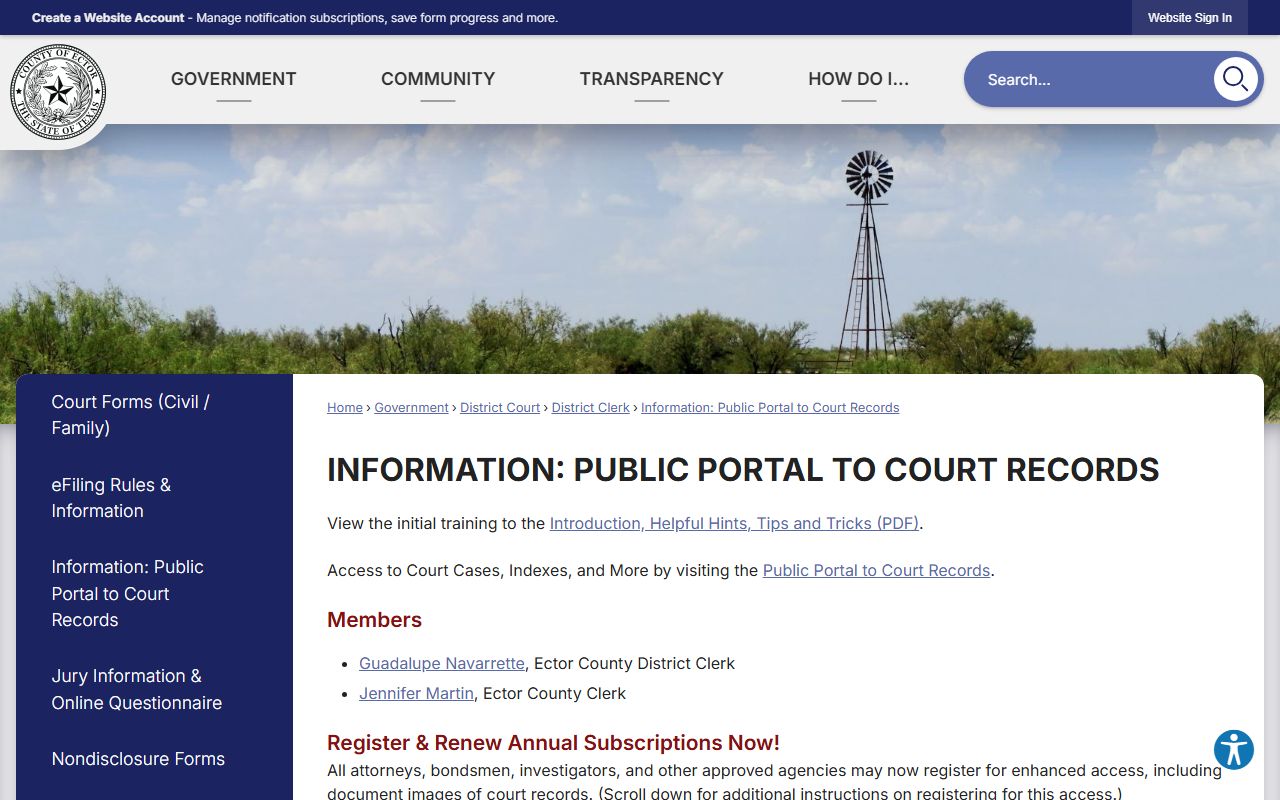
That source matters because the county, not a third-party site, explains which court-record features are free and which require approved registration.
| Search Area | Type | Required | Notes |
|---|---|---|---|
| Smart Search | Search tool | Unspecified | The county confirms Smart Search, but automated inspection was blocked by Tyler/AWS WAF verification. |
| Case number or party name | Likely criteria | Unspecified | Use a known case number when available. Do not assume exact field labels because WAF blocked sample inspection. |
| Index and calendars | Public case data | No account for basic access | The county says free access covers the case index and calendars. |
| Document images | Enhanced access | Approved registration | The county states subscription access is needed for digital document images. |
Access caveat: The official court portal is online, but automated research reached WAF human verification. Use a normal browser, then call the clerk if the portal blocks access or lacks the record.
Find Ector County Arrest Charges
Start with the jail roster only when the question is current custody or booking status. The jail record may list arrest charges, bond, hold notes, or release status, but those fields can differ from what the District Attorney files. Court records after an Ector County arrest should be checked in the court portal once the case has had time to open. Felony cases generally route through district court. Misdemeanors and lower-level criminal matters may route through county courts at law or other court levels.
- Search the jail roster first if the arrest is recent and the person may still be held at the Ector County Detention Center.
- Open the public court portal and search by the person's name or a known case number.
- Check the court level, case number, party name, filed charge, and next hearing or docket event.
- Compare booking charges with filed charges before treating any accusation as the final prosecution record.
- Contact the District Clerk or County Clerk for older records, missing cases, or document access questions.
The Ector County District Clerk lists the courthouse location at 300 N Grant Ave, Room 301, Odessa, TX 79761, with phone 432-498-4290 and email District.Clerk@ectorcountytx.gov. The clerk page also says official filings must follow Texas law and rules and cannot be accepted by fax or email. That rule is about filing documents, not about searching the public index.
Ector County Charging Documents
The arrest does not by itself prove what will be prosecuted. A charging document is the court paper that accuses a person of a crime in a case. Ector County research identifies the key terms used after arrest: complaint, information, indictment, disposition, pending, dismissed, and amended or reduced. These terms help separate the booking record from the court record.
| Document | Who Uses It | Common Role | What to Check |
|---|---|---|---|
| Complaint | Officer or prosecutor | Accusation or early charging instrument, often in lower-court contexts | Name, offense, date, probable-cause basis, and court assignment |
| Information | Prosecutor | Prosecutor-filed charging instrument used for many criminal cases | Filed charge, charge level, amendments, and disposition |
| Indictment | Grand jury | Grand-jury charging instrument for felony prosecution | Count numbers, felony level, enhancements, and arraignment or setting |
The Ector County District Attorney is Dusty Gallivan. The official DA page lists the office at the Ector County Courthouse, 300 North Grant, Room 305, Odessa, TX 79761, with phone 432-498-4230. The office also links a 2026 docket PDF and victim-assistance resources, including Texas Vine Link. Those resources support court and victim-notification work, but they do not replace the clerk's case index.
Ector County Charge Status
Charge status changes as prosecutors, courts, and defendants act on the case. A booking charge can be broad or preliminary. A filed charge can be amended, reduced, enhanced, dismissed, or resolved by plea, verdict, or other disposition. Pending means the case is not over. Dismissed means the charge or case was terminated. Disposition means the case result.
| Status | Plain Meaning | Why It Matters |
|---|---|---|
| Pending | The case or charge remains unresolved. | Future hearings, bond terms, and court orders may still apply. |
| Amended or reduced | The filed charge changed from an earlier version. | The court charge may no longer match the jail booking charge. |
| Dismissed | The charge or case was terminated. | A dismissal is not the same as automatic expunction. |
| Disposition entered | The court recorded an outcome. | The result may be conviction, dismissal, deferred disposition, or another court action. |
| Hold or detainer | Another agency or court may keep custody in place. | Bond on one Ector County case may not end all custody limits. |
Ector County Bond Context
Bond is part of the arrest-to-court path because it affects release while the court record continues. The Ector County Bail Bond Board licenses and regulates companies that offer bail bonds in the county under Texas Occupations Code Chapter 1704 and local rules. The official board page lists local companies and states that the board hears complaints and decides bond-company license issues. Texas Code of Criminal Procedure Chapter 17 governs bail, bond, personal bonds, and related conditions.
| Bond Type | How It Works | Local Checkpoint |
|---|---|---|
| Cash bond | Money is paid to secure release and future appearance. | Confirm payment method with the jail or court because no universal payment table was found. |
| Surety bond | A licensed bail bond company posts bond for the defendant. | Use companies listed by the Ector County Bail Bond Board. |
| Personal or PR bond | Release is based on promise and court conditions rather than full cash payment. | Confirm eligibility through the court or jail record. |
| No-bond hold | Ordinary bond payment will not release the person. | Look for a court order, parole hold, immigration detainer, or other agency hold. |
The Sheriff's ID and Records Division maintains bonding information for people incarcerated in the Ector County Detention Center. A bond amount can be visible in jail or court records, but release can still be blocked by a hold from another jurisdiction, a parole authority, an immigration agency, or a no-bond order.
Ector County Warrants After Arrest
An outstanding warrant can be the reason for a jail arrest, and it can also explain why release is not simple. The Ector County Civil/Warrants Division page says two full-time warrant deputies work with the Lone Star Fugitive Task Force on major felony warrants and work on more than 15,000 warrants housed at the Sheriff's Office. The page says about 1,000 Ector County warrants are served each month by law-enforcement agencies in Ector County and nationwide.
No official Ector County online warrant-search form was located in the research. The local warrant phone line is 432-335-3584. The Civil Division phone is 432-335-3567, and the Sheriff's Office main line is 432-335-3050. Warrant types can include arrest warrants, bench warrants, capias orders, fugitive warrants, and search warrants. A search warrant is not the same as a jail roster record, and deputies cannot give legal advice.
Warrant note: When a warrant is served, booking may create a jail record, but bond and release often depend on the issuing court or agency.
Ector County Charge Comparisons
Two distinctions keep Ector County court records after an arrest from being misread. A charge is an accusation or filed count. A conviction is a final result after plea or verdict. A sealed record is hidden from most public view, while an expunged record is treated much more like it no longer exists under the law.
| Point | Charge | Conviction |
|---|---|---|
| Stage | Accusation at booking or in a filed case | Outcome after plea, verdict, or qualifying disposition |
| Proof level | May start from probable cause or prosecution filing | Requires a court result, not just arrest |
| Public meaning | Does not prove guilt | Can affect sentence, supervision, and background records |
Texas Code of Criminal Procedure Chapter 55 governs expunction, which is the main arrest-record clearing statute. Texas Government Code Chapter 411 governs criminal history record information and DPS dissemination. Eligibility can depend on the charge, disposition, waiting period, prior record, and court order.
| Point | Sealed or Nondisclosed | Expunged |
|---|---|---|
| Public view | Hidden from many public searches | Removed or treated as not existing for many purposes |
| Government access | Some agencies may still have limited access | Access is far more restricted after a valid expunction order |
| Best use case | Eligible records that can be shielded but not destroyed | Eligible arrests, dismissals, acquittals, or other outcomes under Chapter 55 |
Ector County Public Access Limits
The Texas Public Information Act, Government Code Chapter 552, governs requests to Texas governmental bodies for public information, including sheriff and jail records unless an exception applies. Public access does not mean every image, report, or court document is instantly online. Active law-enforcement records, juvenile records, protected personal data, expunction, nondisclosure, and court orders can limit release.
For court images, Ector County states that free portal access covers indexes and calendars, while registered subscription access may be needed for digital document images. For statewide criminal-history information, Texas Government Code Chapter 411 controls dissemination. For arrest procedure and magistrate warnings, Texas Code of Criminal Procedure Chapter 15 is the core statute. For bail and release conditions, Chapter 17 is the better source.